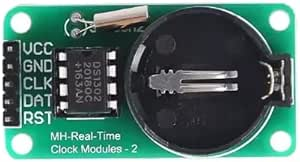
DS1302 Real Time Clock Module RTC Digital Clock Board with Backup Coin Cell Holder, 3-Wire Serial Interface, SMD Version for Arduino AVR ARM PIC Microcontroller Projects
- UAE-wide delivery, 1–2 working days · AED 20 · free on orders AED 100+
- Ships today — order by 3pm
- 7-day returns on unopened items
- SKU
- DIY-00063
- Category
- Misc Accessories
- Min. order
- 1 pc
- Barcode
- DKU-000100
Overview This DS1302 Real Time Clock Module is a compact RTC breakout designed to add calendar and timekeeping capability to microcontroller projects. It is commonly used with Arduino and other platforms (AVR, ARM, PIC) where you need persistent time even when the main system is powered off.
Read the full description ↓1x DS1302 RTC Module (SMD) with coin cell holder
Description
Overview
This DS1302 Real Time Clock Module is a compact RTC breakout designed to add calendar and timekeeping capability to microcontroller projects. It is commonly used with Arduino and other platforms (AVR, ARM, PIC) where you need persistent time even when the main system is powered off. The module uses the DS1302 RTC IC and exposes a simple 3-wire serial interface, making it easy to connect to GPIO pins without requiring a dedicated I2C bus. A coin cell holder on the PCB provides backup power so the RTC can continue running when VCC is removed (exact supported coin cell type and included battery vary by seller/module revision).
Technical Details
The DS1302 communicates using a 3-wire synchronous serial protocol typically consisting of:
- RST (also called CE): chip enable / transaction framing
- CLK (SCLK): serial clock driven by the host MCU
- DAT (I/O): bidirectional data line for reads and writes
Unlike I2C, the DS1302 uses a dedicated enable line and a bidirectional data pin, which can be advantageous when you want deterministic timing and simple bit-banged control on almost any microcontroller. The module breaks out these signals as clearly labeled pins (VCC, GND, CLK, DAT, RST), reducing wiring mistakes during prototyping.
The onboard coin cell holder supplies backup power to the RTC when the main supply is absent. In typical RTC designs, the chip automatically switches to backup supply when VCC drops, preserving time and date registers. Backup retention time depends on coin cell capacity, RTC load current, and temperature; real-world results vary by module revision and battery condition.
Specifications
- RTC IC: DS1302 (SMD package on this module)
- Interface: 3-wire serial (CLK, DAT, RST/CE)
- Logic level: depends on supply voltage used; ensure MCU GPIO levels match the module’s VCC (check datasheet and your module revision)
- Power input: VCC and GND pins (exact operating voltage range varies by module revision; verify against DS1302 datasheet and board markings)
- Backup power: onboard coin cell holder (battery type varies by module revision; commonly CR2032-style holders are used—confirm by inspection)
- PCB: compact module with mounting holes (dimensions vary by module revision)
- Pin labels (as shown on typical boards): VCC, GND, CLK, DAT, RST
Applications
- Arduino-based clocks, timers, and scheduled switching
- Data loggers requiring time-stamped measurements (temperature, humidity, power usage, etc.)
- Automation controllers that must keep time during outages
- Attendance/time tracking prototypes and embedded UI clocks
- Robotics projects needing time-based events and maintenance intervals
Integration Notes
- Connect VCC and GND to your system power and ground. Use a stable supply and good grounding to reduce timekeeping errors caused by noise.
- Connect CLK, DAT, and RST to available digital GPIO pins. DAT is bidirectional; configure your MCU pin direction appropriately during read/write cycles.
- Use a DS1302-compatible library for your platform. Many Arduino libraries support DS1302 and handle register formatting for time/date.
- Install a compatible coin cell in the holder for backup operation. If your module ships with a battery, verify its voltage before use.
- If you experience unreliable communication, keep wires short, avoid breadboard contact issues, and consider adding decoupling near VCC (some boards include it; others vary by revision).
Included Components
1x DS1302 RTC Module (SMD) with coin cell holder
Specifications
No reviews yet · be the first
Sign in to review a product you have bought - or use the review link in your order email, which needs no account and marks your review as a verified purchase.
Related components
%22%2F%3E%3Cellipse%20cx%3D%2228%22%20cy%3D%2224%22%20rx%3D%2226%22%20ry%3D%2214%22%20fill%3D%22rgba(255%2C255%2C255%2C.18)%22%2F%3E%3Crect%20x%3D%2222%22%20y%3D%2228%22%20width%3D%2256%22%20height%3D%2250%22%20rx%3D%2212%22%20fill%3D%22url(%23b)%22%20filter%3D%22url(%23s)%22%2F%3E%3Cellipse%20cx%3D%2234%22%20cy%3D%2236%22%20rx%3D%2212%22%20ry%3D%226%22%20fill%3D%22rgba(255%2C255%2C255%2C.28)%22%20transform%3D%22rotate(-18%2034%2036)%22%2F%3E%3Crect%20x%3D%2234%22%20y%3D%2215%22%20width%3D%225%22%20height%3D%2214%22%20rx%3D%222.5%22%20fill%3D%22%236ee7b7%22%2F%3E%3Crect%20x%3D%2261%22%20y%3D%2215%22%20width%3D%225%22%20height%3D%2214%22%20rx%3D%222.5%22%20fill%3D%22%236ee7b7%22%2F%3E%3Ccircle%20cx%3D%2236.5%22%20cy%3D%2214%22%20r%3D%224%22%20fill%3D%22%23a7f3d0%22%2F%3E%3Ccircle%20cx%3D%2263.5%22%20cy%3D%2214%22%20r%3D%224%22%20fill%3D%22%23a7f3d0%22%2F%3E%3Crect%20x%3D%2228%22%20y%3D%2242%22%20width%3D%2244%22%20height%3D%2222%22%20rx%3D%226%22%20fill%3D%22%23022c22%22%2F%3E%3Cline%20x1%3D%2228%22%20y1%3D%2250%22%20x2%3D%2272%22%20y2%3D%2250%22%20stroke%3D%22%2334d399%22%20stroke-width%3D%22.8%22%20stroke-opacity%3D%22.5%22%2F%3E%3Cline%20x1%3D%2228%22%20y1%3D%2257%22%20x2%3D%2272%22%20y2%3D%2257%22%20stroke%3D%22%2334d399%22%20stroke-width%3D%22.8%22%20stroke-opacity%3D%22.5%22%2F%3E%3Cline%20x1%3D%2244%22%20y1%3D%2242%22%20x2%3D%2244%22%20y2%3D%2264%22%20stroke%3D%22%2334d399%22%20stroke-width%3D%22.8%22%20stroke-opacity%3D%22.5%22%2F%3E%3Cline%20x1%3D%2256%22%20y1%3D%2242%22%20x2%3D%2256%22%20y2%3D%2264%22%20stroke%3D%22%2334d399%22%20stroke-width%3D%22.8%22%20stroke-opacity%3D%22.5%22%2F%3E%3Ccircle%20cx%3D%2238%22%20cy%3D%2252%22%20r%3D%226%22%20fill%3D%22%2334d399%22%20opacity%3D%22.9%22%2F%3E%3Ccircle%20cx%3D%2262%22%20cy%3D%2252%22%20r%3D%226%22%20fill%3D%22%2334d399%22%20opacity%3D%22.9%22%2F%3E%3Ccircle%20cx%3D%2236.5%22%20cy%3D%2250.5%22%20r%3D%222%22%20fill%3D%22white%22%2F%3E%3Ccircle%20cx%3D%2260.5%22%20cy%3D%2250.5%22%20r%3D%222%22%20fill%3D%22white%22%2F%3E%3Cpath%20d%3D%22M36%2068%20Q50%2076%2064%2068%22%20fill%3D%22none%22%20stroke%3D%22%23022c22%22%20stroke-width%3D%222.5%22%20stroke-linecap%3D%22round%22%2F%3E%3C%2Fsvg%3E)