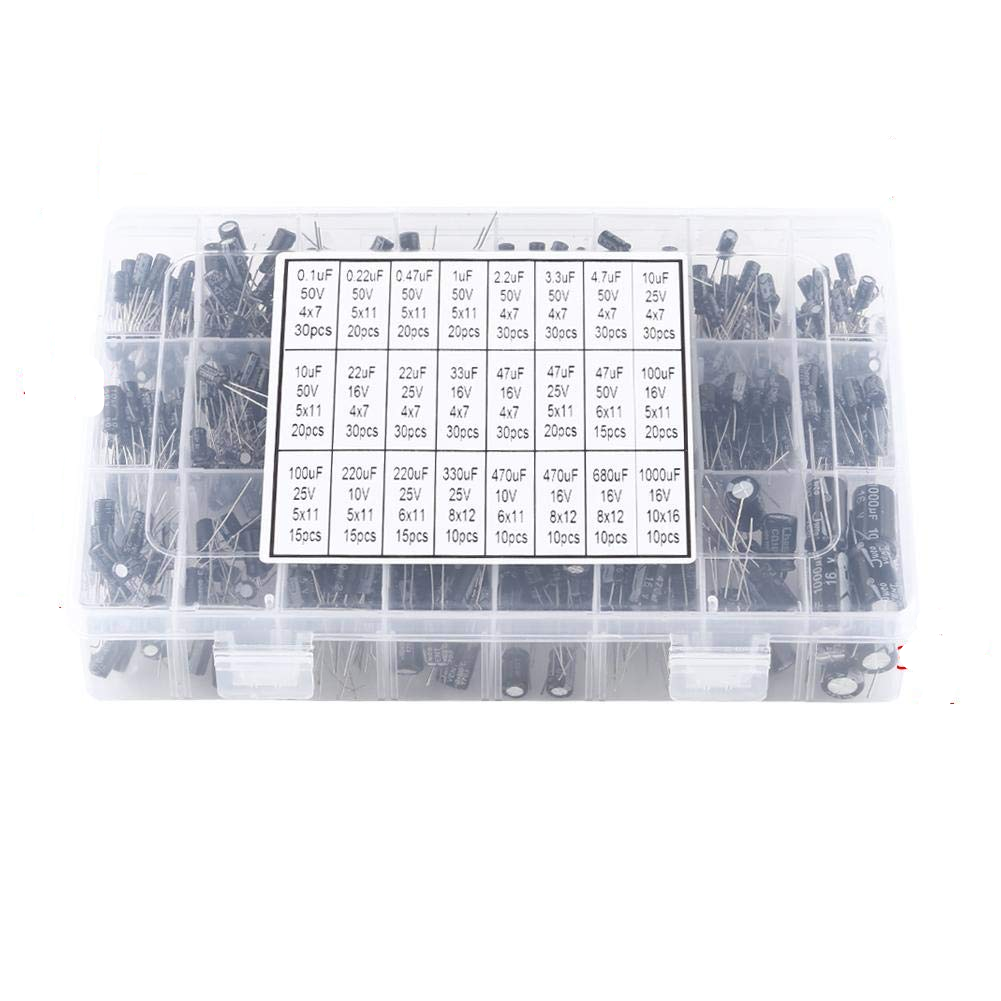
500 Piece Electrolytic Capacitor Kit - 24 Values 0.1uF to 1000uF, 10V-50V Radial Assortment Box for Arduino, Power Supply & Repair Work
- UAE-wide delivery, 1–3 working days · free on orders AED 150+
- Ships today for orders before 3pm
- 7-day returns on unopened items
- SKU
- DIY-346
- Category
- Components
- Brand / MPN
- DIYKIT
- Min. order
- 1 pc
- Barcode
- DKU-000392
A capacitor kit is only useful if the voltage rating is right for the rail you are on. That is why this box carries the popular values more than once: 10µF at 25V and 50V, 22µF at 16V and 25V, 47µF at 16V, 25V and 50V, 100µF at 16V and 25V, 220µF at 10V and 25V, 470µF at 10V and 16V.
Read the full description ↓| Value | Voltage | Body (mm) | Pieces |
|---|---|---|---|
| 0.1µF | 50V | 4 x 7 | 30 |
| 0.22µF | 50V | 5 x 11 | 20 |
| 0.47µF | 50V | 5 x 11 | 20 |
| 1µF | 50V | 5 x 11 | 20 |
| 2.2µF | 50V | 4 x 7 | 30 |
| 3.3µF | 50V | 4 x 7 | 30 |
| 4.7µF | 50V | 4 x 7 | 30 |
| 10µF | 25V | 4 x 7 | 30 |
| 10µF | 50V | 5 x 11 | 20 |
| 22µF | 16V | 4 x 7 | 30 |
| 22µF | 25V | 4 x 7 | 30 |
| 33µF | 16V | 4 x 7 | 30 |
| 47µF | 16V | 4 x 7 | 30 |
| 47µF | 25V | 5 x 11 | 20 |
| 47µF | 50V | 6 x 11 | 15 |
| 100µF | 16V | 5 x 11 | 20 |
| 100µF | 25V | 5 x 11 | 15 |
| 220µF | 10V | 5 x 11 | 15 |
| 220µF | 25V | 6 x 11 | 15 |
| 330µF | 25V | 8 x 12 | 10 |
| 470µF | 10V | 6 x 11 | 10 |
| 470µF | 16V | 8 x 12 | 10 |
| 680µF | 16V | 8 x 12 | 10 |
| 1000µF | 16V | 10 x 16 | 10 |
24 values, 500 pieces in total.
Description
A capacitor kit is only useful if the voltage rating is right for the rail you are on. That is why this box carries the popular values more than once: 10µF at 25V and 50V, 22µF at 16V and 25V, 47µF at 16V, 25V and 50V, 100µF at 16V and 25V, 220µF at 10V and 25V, 470µF at 10V and 16V. You pick the right part instead of the nearest compromise.
500 radial aluminium electrolytic capacitors across 24 values, from 0.1µF to 1000µF, in a 24-compartment hinged case with capacitance, voltage and body size printed on every compartment.
Values included
| Value | Voltage | Body (mm) | Pieces |
|---|---|---|---|
| 0.1µF | 50V | 4 x 7 | 30 |
| 0.22µF | 50V | 5 x 11 | 20 |
| 0.47µF | 50V | 5 x 11 | 20 |
| 1µF | 50V | 5 x 11 | 20 |
| 2.2µF | 50V | 4 x 7 | 30 |
| 3.3µF | 50V | 4 x 7 | 30 |
| 4.7µF | 50V | 4 x 7 | 30 |
| 10µF | 25V | 4 x 7 | 30 |
| 10µF | 50V | 5 x 11 | 20 |
| 22µF | 16V | 4 x 7 | 30 |
| 22µF | 25V | 4 x 7 | 30 |
| 33µF | 16V | 4 x 7 | 30 |
| 47µF | 16V | 4 x 7 | 30 |
| 47µF | 25V | 5 x 11 | 20 |
| 47µF | 50V | 6 x 11 | 15 |
| 100µF | 16V | 5 x 11 | 20 |
| 100µF | 25V | 5 x 11 | 15 |
| 220µF | 10V | 5 x 11 | 15 |
| 220µF | 25V | 6 x 11 | 15 |
| 330µF | 25V | 8 x 12 | 10 |
| 470µF | 10V | 6 x 11 | 10 |
| 470µF | 16V | 8 x 12 | 10 |
| 680µF | 16V | 8 x 12 | 10 |
| 1000µF | 16V | 10 x 16 | 10 |
24 values, 500 pieces in total.
What each end of the range is for
| Range | Typical use |
|---|---|
| 0.1µF to 4.7µF | Coupling between audio stages, RC timing, bypassing a reference pin |
| 10µF to 47µF | Regulator input and output capacitors; the value an LM7805 or AMS1117 datasheet asks for |
| 100µF to 220µF | Local reservoir near a motor driver, relay board or servo header |
| 330µF to 1000µF | Bulk smoothing after a rectifier, and holding up a 3.3V rail when an ESP32 transmits |
Specifications
| Item | Detail |
|---|---|
| Total pieces | 500 |
| Values | 24 |
| Capacitance range | 0.1µF to 1000µF |
| Voltage range | 10V to 50V |
| Type | Radial aluminium electrolytic, through-hole |
| Polarity | Polarised - the negative lead is marked with a stripe |
| Body sizes | 4 x 7mm to 10 x 16mm |
| Lead style | Radial, 0.1 inch breadboard and PCB compatible |
| Storage | 24-compartment hinged case, each compartment labelled with value, voltage and size |
What it is for
- Smoothing a rectified supply in a linear power supply build
- Input and output capacitors for 7805, AMS1117 and LM317 regulators
- Bulk decoupling near motors, servos, relays and stepper drivers, where the current spike would otherwise drag the rail down
- Holding up the 3.3V rail on an ESP32 or ESP8266 during WiFi transmit bursts - the usual cure for a board that resets when it connects
- Audio coupling between amplifier stages
- RC timing circuits, 555 timers and soft-start networks
- Repair work on power supplies, adapters, monitors and appliance boards, where dried-out electrolytics are the most common failure
Working with them
Polarity first. These are polarised. The stripe down the can marks the negative lead, and the positive lead is longer on a new part. Fitted backwards, an electrolytic heats, vents and can burst. Check twice before powering a new board.
Rate the voltage generously. Choose a capacitor rated for roughly twice the working voltage. On a 5V rail use a 16V or 25V part; on 12V use 25V or more. Running an electrolytic near its rated voltage shortens its life sharply, and running it over will destroy it.
Put them close. A reservoir capacitor works through the loop it sits in, so it belongs next to the part that draws the current, not at the far end of the board. Millimetres matter more than microfarads here.
Pair with a ceramic. Electrolytics handle bulk energy but have too much internal resistance and inductance to clean up fast switching edges. For high-frequency decoupling right at an IC supply pin, a small ceramic alongside is the standard practice - the electrolytic holds the rail, the ceramic handles the transients.
Discharge before handling. A large capacitor in a powered-down supply can hold a charge for some time. Bleed it through a resistor before probing.
Works with
Arduino UNO, Nano and Mega, ESP32, ESP8266, STM32, Raspberry Pi and Pi Pico, plus breadboards, perfboard, through-hole PCBs and general repair work. Nothing here is board-specific.
Related components