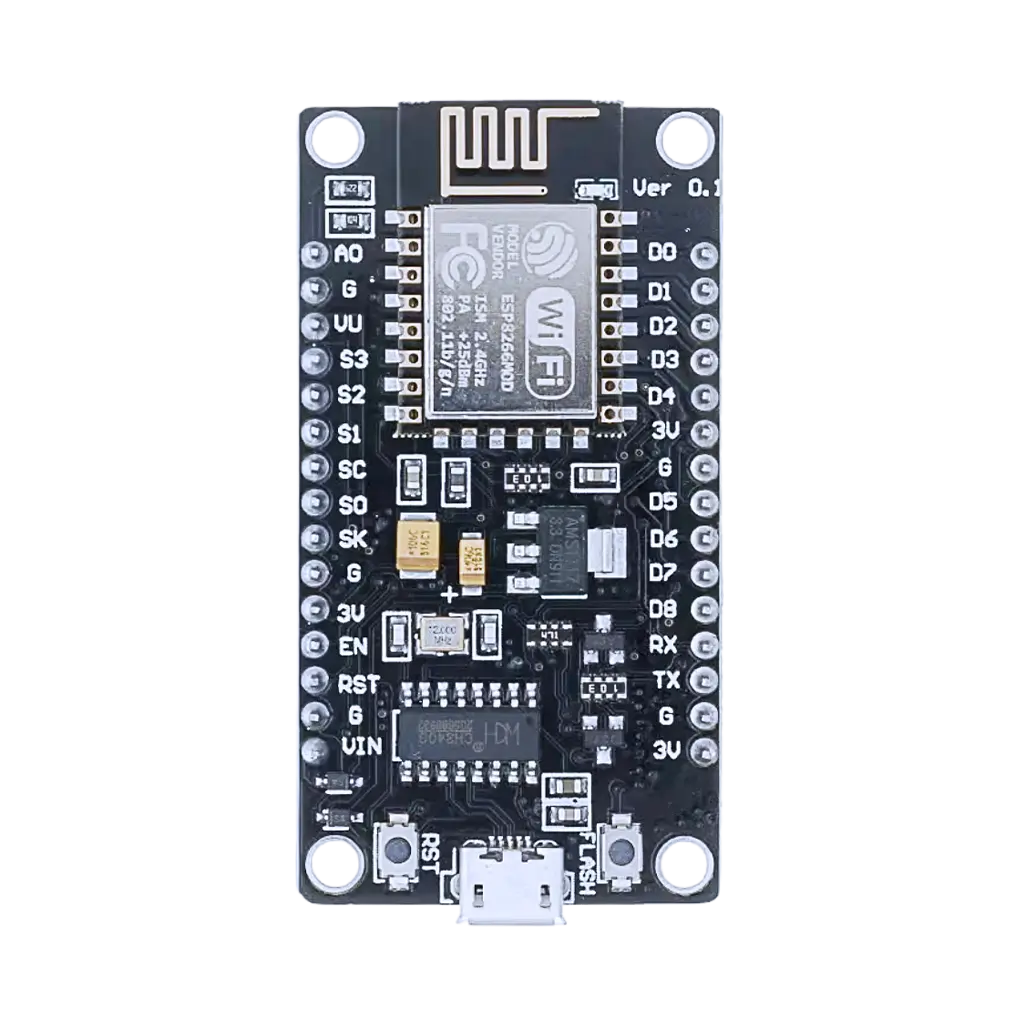
ESP8266 WiFi Serial Transceiver Module - Low-Power Wireless IoT Board for Arduino and Microcontroller Projects
- UAE-wide delivery, 1–3 working days · free over AED 150
- Ships today for orders before 3pm
- 7-day returns on unopened items
- SKU
- DIY-341
- Category
- ESP32 / WiFi Modules
- Min. order
- 1 pc
- Barcode
- DKU-000386
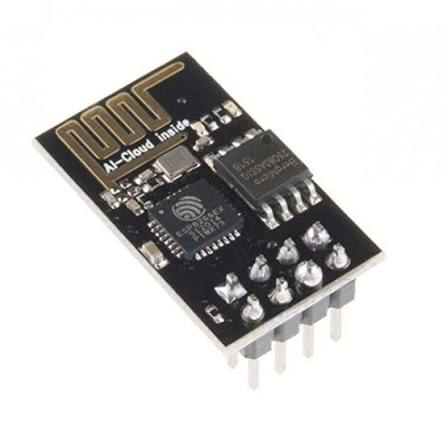
Overview The ESP8266 WiFi Serial Transceiver Module is a highly integrated system-on-chip engineered to provide internet connectivity to a vast array of microcontroller-based electronics projects.
Read the full description ↓1x ESP8266 WiFi Module
Description
Overview
The ESP8266 WiFi Serial Transceiver Module is a highly integrated system-on-chip engineered to provide internet connectivity to a vast array of microcontroller-based electronics projects. Designed specifically for Internet of Things developers, makers, and hobbyists, this standalone wireless networking solution eliminates the complexity of adding network access to embedded systems. By offloading TCP/IP stack management and WiFi processing from the primary microcontroller, the ESP8266 enables developers to build smart, connected devices with minimal hardware modifications. Whether you are designing a remote environmental monitoring station, a smart home lighting controller, or a cloud-connected robotics platform, this versatile wireless module delivers reliable performance and exceptional value.
Technical Details
At the core of the ESP8266 module is a Tensilica L106 32-bit RISC microprocessor operating at a selectable clock frequency of 80 MHz or 160 MHz. The system includes an on-chip switching regulator and a high-efficiency power management unit designed to maintain stable operation under fluctuating load conditions. Wireless connectivity is handled by an integrated radio frequency transceiver operating in the 2.4 GHz ISM band, supporting 802.11 b, g, and n protocols with security standards such as WPA and WPA2. The module provides multiple operating modes, allowing it to function as a client connecting to an existing wireless router, as an independent access point hosting its own local network, or simultaneously as both. Data transmission and reception are managed through standard serial Universal Asynchronous Receiver-Transmitter communication, making it natively compatible with Arduino, STM32, PIC, and AVR development boards through simple AT commands or custom firmware flashed directly to the onboard flash memory.
Specifications
Operating voltage range varies by module revision and typically requires regulated 3.3 volts for safe and reliable operation. Logic level compatibility is generally 3.3 volts, requiring external level shifting components when interfacing with 5-volt microcontrollers. Flash memory capacity varies by module revision, commonly available in 1 megabyte, 2 megabytes, or 4 megabytes configurations. Transmission output power reaches up to plus 19.5 dBm in 802.11b mode, ensuring robust signal propagation over extended distances. Current consumption varies significantly depending on operational states, ranging from microamps in deep sleep mode to approximately 70 milliamps during continuous data transmission. The module features integrated antenna support through a printed on-board trace or an external connector depending on the specific board layout variant.
Applications
The ESP8266 WiFi module is widely deployed across a diverse spectrum of modern electronic applications. In home automation, it serves as the core wireless interface for smart plugs, connected wall switches, automated window blinds, and remote thermostat controllers. For environmental sensing, it enables remote weather stations, soil moisture monitors, and air quality detectors to transmit real-time telemetry data directly to cloud dashboards or local databases via MQTT or HTTP protocols. Industrial IoT engineers utilize the module for asset tracking, remote equipment status monitoring, and predictive maintenance sensor nodes. Educational institutions and maker communities leverage its extensive community support and rich ecosystem for rapid prototyping of connected robotics, wearable technology, and interactive art installations.
Integration Notes
Proper power supply design is critical when integrating the ESP8266 into your electronic projects. The module can draw peak currents exceeding 200 milliamps during RF transmission bursts, meaning that powering it directly from the 3.3V output pin of a standard Arduino Uno is insufficient and will cause instability or system resets. An independent, high-current 3.3V regulated power source must be utilized. Ensure that all data lines connected to the general-purpose input output pins do not exceed 3.3V logic levels to prevent permanent hardware damage. Pull-up resistors on specific bootstrap pins such as GPIO0, GPIO2, and CH_PD are required to ensure correct boot mode selection upon power-up. Always consult the specific hardware schematic and datasheet for your exact module layout variation to verify pinout configurations and memory specifications.
Included Components
1x ESP8266 WiFi Module
Specifications
Related components