Nano V3 Development Board with ATMEGA328P Microcontroller, USB Type-C Interface, 43.1mm x 18.4mm Compact Arduino-Compatible Controller for DIY Prototyping
Overview This Nano V3 Development Board is a compact, Arduino-compatible microcontroller platform built around the ATMEGA328P. It is designed for space-constrained electronics projects where you still want the familiar Nano form factor and a straightforward workflow for programming and powering the board.
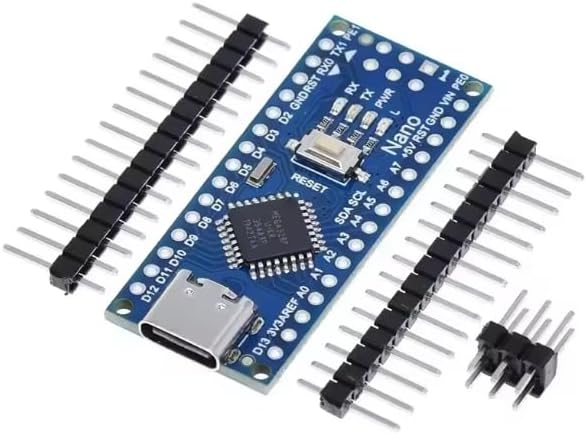
1x Nano V3 Type-C board, 2x long pin headers, 1x short header
Overview
This Nano V3 Development Board is a compact, Arduino-compatible microcontroller platform built around the ATMEGA328P. It is designed for space-constrained electronics projects where you still want the familiar Nano form factor and a straightforward workflow for programming and powering the board. The USB Type-C connector provides a modern physical interface for connecting to a computer or 5V USB power source, while the pin layout exposes the core ATMEGA328P I/O for quick wiring to sensors, modules, and actuators.
The board is well-suited for DIY prototyping, classroom labs, and small embedded controllers. Its small size (43.1mm x 18.4mm) makes it easy to mount in enclosures or plug into a breadboard (with appropriate header orientation). Because Nano V3-style boards can differ slightly by production batch (for example, the USB-to-serial controller and bootloader configuration), it’s recommended to confirm your exact board revision in your IDE settings and consult the ATMEGA328P datasheet for electrical limits.
Technical Details
At the core is the ATMEGA328P 8-bit AVR MCU, commonly used in Arduino-compatible designs. It provides a mix of digital GPIO and analog input channels, enabling typical embedded tasks such as reading potentiometers and sensors, generating PWM for motor speed/LED dimming, and communicating with peripherals over UART/I2C/SPI (pin mapping depends on the Nano standard layout). Programming is typically performed over USB via an onboard USB-to-serial interface (chip type varies by module revision), which bridges the computer’s USB connection to the ATMEGA328P serial bootloader.
Power can be supplied from the USB Type-C port or via board power pins depending on your wiring. When integrating with external modules (servos, relays, RF modules, LED strips), ensure your power budget is appropriate: the microcontroller board is intended as a controller, not a high-current power source. Use separate regulated supplies for high-load devices and connect grounds together for a common reference.
Specifications
- Microcontroller: ATMEGA328P
- Board form factor: Nano V3 compatible (pinout follows Nano-style layout; confirm with silkscreen)
- USB connector: USB Type-C
- Dimensions: 43.1mm x 18.4mm
- Logic level: typically 5V for ATMEGA328P Nano-style boards (verify your module revision)
- Input voltage / power options: varies by module revision; commonly powered via USB 5V and/or VIN pin (check board markings and datasheet)
- Clock frequency: varies by module revision (commonly 16 MHz on Nano-style ATMEGA328P boards; verify on your board)
- USB-to-serial interface: varies by module revision (check onboard IC markings)
- I/O: digital GPIO and analog inputs available on Nano-style headers (exact count and mapping follow Nano conventions; verify silkscreen)
Applications
- Breadboard prototyping for sensors (temperature, light, motion), buttons, and basic control logic
- PWM control for LEDs, dimmers, and small motor drivers (use external drivers for motors)
- Data logging and serial communication projects (UART/I2C/SPI depending on wiring)
- Robotics sub-controllers for reading sensors and controlling servos via external power
- Compact embedded controllers for home automation, alarms, and custom instruments
Integration Notes
- IDE/bootloader selection may depend on the specific Nano V3-compatible revision; if upload fails, confirm the correct board/processor setting and USB driver requirements for your USB-serial chip.
- Do not power high-current loads from the board’s 5V pin unless you have verified regulator/USB current limits; use a dedicated supply for motors, relays, and LED strips.
- For reliable analog readings, keep sensor wiring short, use proper grounding, and consider decoupling capacitors near noisy loads.
- If mounting in a breadboard, solder the included headers straight and ensure correct orientation to match the Nano pinout.
Included Components
1x Nano V3 Type-C board, 2x long pin headers, 1x short header
No reviews for this component yet.
Related Components