Arduino Nano Compatible Board (ATmega328P) with Micro USB, Mini Development Board for DIY Projects
More options
Build compact and reliable DIY electronics with an Arduino Nano compatible board based on the ATmega328P microcontroller. Designed for makers who need a small, breadboard-friendly controller, this Nano-style development board is a popular choice for projects where space matters but you still want the simplicity and wide software support of the Arduino ecosystem. It’s ideal for prototyping, learning, and building finished devices such as small robots, automation controllers, sensor hubs, and interactive electronics.
The Micro USB interface makes setup simple. You can power the board and upload sketches through a common Micro USB cable, helping you get started quickly with minimal wiring. Once programmed, the board can run standalone inside a project enclosure, powered from a suitable 5V supply (depending on your project design). Many DIY users choose Nano boards because they fit easily on breadboards and prototyping boards, letting you test sensors and modules without large footprints.
This board provides a strong balance of I/O options for typical projects. With a mix of digital pins and analog input pins, you can connect buttons, LEDs, buzzers, relays, servos, sensors, and communication modules. It’s commonly used for PWM control, reading analog sensors, driving small loads (with proper driver modules), and communicating via standard serial interfaces. Because the Nano is so widely supported, you can find many example codes and libraries for popular sensors and modules, making it an excellent board for beginners and also a practical option for experienced builders who want a compact controller.
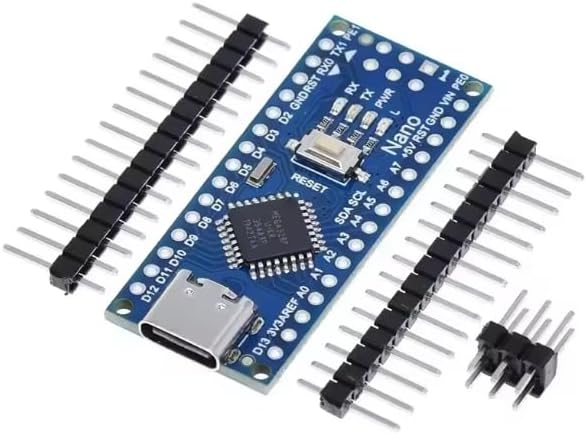
The included pin headers (as shown) help you solder the board for breadboard use or for permanent installation on a prototyping PCB. Depending on your build, you can use straight headers for breadboards or angle headers for side access. For best reliability, solder carefully and avoid strain on the Micro USB port, especially in projects where the board is frequently connected and disconnected.
Typical uses include robot control, LED lighting effects, small automation systems, sensor reading and data logging, basic IoT gateways (with additional modules), and educational electronics labs. If you are powering motors, relays, heaters, or other higher-current devices, always use the correct driver circuits and separate power supplies when required to protect the board.
This Arduino Nano compatible Micro USB board is a practical, cost-effective controller for everyday DIY builds—small enough for compact projects, powerful enough for a wide range of sensors and automation tasks, and supported by the huge Arduino community.
Included Components
1× Arduino Nano compatible board (Micro USB)
2× Long pin header strips
1× Short pin header strip
Full description
Build compact and reliable DIY electronics with an Arduino Nano compatible board based on the ATmega328P microcontroller. Designed for makers who need a small, breadboard-friendly controller, this Nano-style development board is a popular choice for projects where space matters but you still want the simplicity and wide software support of the Arduino ecosystem. It’s ideal for prototyping, learning, and building finished devices such as small robots, automation controllers, sensor hubs, and interactive electronics.
The Micro USB interface makes setup simple. You can power the board and upload sketches through a common Micro USB cable, helping you get started quickly with minimal wiring. Once programmed, the board can run standalone inside a project enclosure, powered from a suitable 5V supply (depending on your project design). Many DIY users choose Nano boards because they fit easily on breadboards and prototyping boards, letting you test sensors and modules without large footprints.
This board provides a strong balance of I/O options for typical projects. With a mix of digital pins and analog input pins, you can connect buttons, LEDs, buzzers, relays, servos, sensors, and communication modules. It’s commonly used for PWM control, reading analog sensors, driving small loads (with proper driver modules), and communicating via standard serial interfaces. Because the Nano is so widely supported, you can find many example codes and libraries for popular sensors and modules, making it an excellent board for beginners and also a practical option for experienced builders who want a compact controller.
The included pin headers (as shown) help you solder the board for breadboard use or for permanent installation on a prototyping PCB. Depending on your build, you can use straight headers for breadboards or angle headers for side access. For best reliability, solder carefully and avoid strain on the Micro USB port, especially in projects where the board is frequently connected and disconnected.
Typical uses include robot control, LED lighting effects, small automation systems, sensor reading and data logging, basic IoT gateways (with additional modules), and educational electronics labs. If you are powering motors, relays, heaters, or other higher-current devices, always use the correct driver circuits and separate power supplies when required to protect the board.
This Arduino Nano compatible Micro USB board is a practical, cost-effective controller for everyday DIY builds—small enough for compact projects, powerful enough for a wide range of sensors and automation tasks, and supported by the huge Arduino community.
Included Components
1× Arduino Nano compatible board (Micro USB)
2× Long pin header strips
1× Short pin header strip
No reviews yet — be the first.
Honest takes from buyers who built with this part.
Write a review
No questions yet.
Ask anything — the team and other customers will reply.
Ask a question
Starter Bundle Builder
Works With
Find more compatible parts
Related