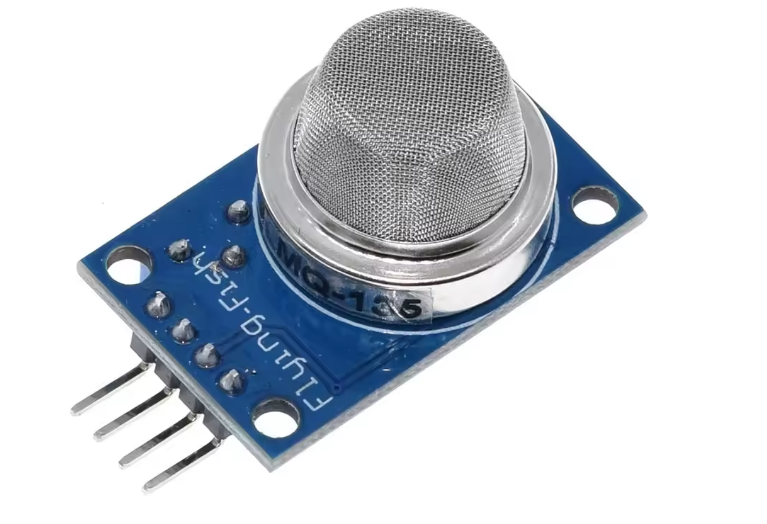
MQ-135 Air Quality Gas Sensor Detection Module for Arduino & DIY, Analog Output, Detects CO2/Ammonia/Smoke/VOCs, Adjustable Sensitivity with Onboard Potentiometer, 5V Compatible
plus AED 20 delivery · free over AED 100
- UAE-wide delivery, 1–2 working days once dispatched · AED 20 · free on orders AED 100+
- Out of stock — leave your email above and we tell you when it is back
- 7-day returns on unopened items
- SKU
- MQ-135
- Category
- Sensors
- Min. order
- 1 pc
- Barcode
- DKU-000010
Overview The MQ-135 Air Quality Sensor Module is a popular, cost-effective gas sensing solution designed for DIY air-quality projects and embedded monitoring systems. It is based on a heated metal-oxide semiconductor (MOS) sensing element whose resistance changes when exposed to certain gases.
Read the full description ↓1x MQ-135 Air Quality Sensor Detection Module
Description
Overview
The MQ-135 Air Quality Sensor Module is a popular, cost-effective gas sensing solution designed for DIY air-quality projects and embedded monitoring systems. It is based on a heated metal-oxide semiconductor (MOS) sensing element whose resistance changes when exposed to certain gases. The MQ-135 is commonly used as a “general air quality” sensor because it reacts to a broad mix of gases found in indoor environments, including CO2-related air quality changes, ammonia (NH3), smoke, alcohol vapors, benzene, and other VOC-like compounds. Because it is cross-sensitive by nature, it is best suited for relative air-quality indication, trend tracking, and threshold alarms rather than certified, laboratory-accurate CO2 measurement.
Technical Details
Inside the MQ-135 sensing head is a heater coil and a sensitive layer whose conductivity varies with gas adsorption. The heater must be powered to bring the sensing element to its operating temperature; this is why MQ-series sensors draw more current than typical low-power sensors. The module typically exposes an analog output (AO) that represents the sensor’s voltage across a load resistor (RL) in a divider with the sensor resistance (Rs). As gas concentration changes, Rs changes, shifting the AO voltage. Many module revisions also include a comparator circuit and a trimmer potentiometer to set a threshold for a digital output (DO). If your board includes DO, it can be used to trigger an alarm when the sensed level crosses the set point; if it does not, you can still implement thresholds in software using the analog reading.
For meaningful results, the MQ-135 requires warm-up and stabilization. Initial burn-in time can be significant (check datasheet), and day-to-day readings can drift with temperature, humidity, sensor aging, and supply variations. For best performance, power the sensor from a stable 5V source, allow adequate warm-up before sampling, and use averaging/filters in firmware. If you plan to estimate ppm values, you must calibrate the sensor in known conditions to determine R0 (sensor resistance in clean air) and then apply the appropriate sensitivity curves from the datasheet. Note that “CO2 sensor” in hobby contexts often refers to air-quality correlation rather than selective NDIR CO2 measurement; MQ-135 is not an NDIR sensor and will respond to multiple gases.
Specifications
- Sensor type: Heated MOS gas sensor (MQ-135 element on module)
- Target gases: Broad air-quality gases; sensitivity varies by gas and environment (check datasheet)
- Outputs: Analog output (AO) standard; digital output (DO) may be present depending on module revision
- Supply voltage: Typically 5V for heater operation (module revision dependent; check silkscreen/datasheet)
- Interface: AO to ADC input; optional DO to digital GPIO (if comparator circuit included)
- Calibration: Requires warm-up and baseline calibration (R0) for any ppm estimation; otherwise use relative readings
- Accuracy: Not a precision CO2 meter; readings are influenced by multiple gases, humidity, and temperature
- Power/Current: Heater current varies by module revision and operating conditions (check datasheet)
- Operating environment: Performance varies with temperature/humidity; allow stabilization time for consistent results
Applications
- DIY indoor air quality indicator (relative VOC/smoke/air-quality changes)
- Ventilation and fan control prototypes using threshold logic
- Pollution/smoke presence alarms (with software filtering or DO threshold when available)
- Classroom/lab demonstrations of gas sensing and ADC signal processing
- Smart home experiments integrating air-quality trends into automation rules
Integration Notes
Connect VCC and GND to a stable supply (commonly 5V). Route AO to an ADC-capable pin on your controller; for ESP32 and other 3.3V ADC systems, ensure the AO voltage range is compatible (use a divider if needed, depending on your module’s output swing). If your module includes DO, connect it to a digital input and adjust the onboard potentiometer to set the trigger threshold; verify the DO logic level with your controller’s voltage tolerance. Allow warm-up time before taking readings, then sample periodically and apply averaging (moving average or median filtering) to reduce noise. For ppm-style estimation, follow the datasheet procedure: determine R0 in clean air, compute Rs from the measured voltage and RL, then apply the appropriate curve parameters. Always treat results as indicative unless calibrated against known references.
Included Components
1x MQ-135 Air Quality Sensor Detection Module
Specifications
No reviews yet · be the first
Sign in to review a product you have bought - or use the review link in your order email, which needs no account and marks your review as a verified purchase.
Related components
 In Stock
%22%2F%3E%3Cellipse%20cx%3D%2228%22%20cy%3D%2224%22%20rx%3D%2226%22%20ry%3D%2214%22%20fill%3D%22rgba(255%2C255%2C255%2C.18)%22%2F%3E%3Crect%20x%3D%2222%22%20y%3D%2228%22%20width%3D%2256%22%20height%3D%2250%22%20rx%3D%2212%22%20fill%3D%22url(%23b)%22%20filter%3D%22url(%23s)%22%2F%3E%3Cellipse%20cx%3D%2234%22%20cy%3D%2236%22%20rx%3D%2212%22%20ry%3D%226%22%20fill%3D%22rgba(255%2C255%2C255%2C.28)%22%20transform%3D%22rotate(-18%2034%2036)%22%2F%3E%3Crect%20x%3D%2234%22%20y%3D%2215%22%20width%3D%225%22%20height%3D%2214%22%20rx%3D%222.5%22%20fill%3D%22%236ee7b7%22%2F%3E%3Crect%20x%3D%2261%22%20y%3D%2215%22%20width%3D%225%22%20height%3D%2214%22%20rx%3D%222.5%22%20fill%3D%22%236ee7b7%22%2F%3E%3Ccircle%20cx%3D%2236.5%22%20cy%3D%2214%22%20r%3D%224%22%20fill%3D%22%23a7f3d0%22%2F%3E%3Ccircle%20cx%3D%2263.5%22%20cy%3D%2214%22%20r%3D%224%22%20fill%3D%22%23a7f3d0%22%2F%3E%3Crect%20x%3D%2228%22%20y%3D%2242%22%20width%3D%2244%22%20height%3D%2222%22%20rx%3D%226%22%20fill%3D%22%23022c22%22%2F%3E%3Cline%20x1%3D%2228%22%20y1%3D%2250%22%20x2%3D%2272%22%20y2%3D%2250%22%20stroke%3D%22%2334d399%22%20stroke-width%3D%22.8%22%20stroke-opacity%3D%22.5%22%2F%3E%3Cline%20x1%3D%2228%22%20y1%3D%2257%22%20x2%3D%2272%22%20y2%3D%2257%22%20stroke%3D%22%2334d399%22%20stroke-width%3D%22.8%22%20stroke-opacity%3D%22.5%22%2F%3E%3Cline%20x1%3D%2244%22%20y1%3D%2242%22%20x2%3D%2244%22%20y2%3D%2264%22%20stroke%3D%22%2334d399%22%20stroke-width%3D%22.8%22%20stroke-opacity%3D%22.5%22%2F%3E%3Cline%20x1%3D%2256%22%20y1%3D%2242%22%20x2%3D%2256%22%20y2%3D%2264%22%20stroke%3D%22%2334d399%22%20stroke-width%3D%22.8%22%20stroke-opacity%3D%22.5%22%2F%3E%3Ccircle%20cx%3D%2238%22%20cy%3D%2252%22%20r%3D%226%22%20fill%3D%22%2334d399%22%20opacity%3D%22.9%22%2F%3E%3Ccircle%20cx%3D%2262%22%20cy%3D%2252%22%20r%3D%226%22%20fill%3D%22%2334d399%22%20opacity%3D%22.9%22%2F%3E%3Ccircle%20cx%3D%2236.5%22%20cy%3D%2250.5%22%20r%3D%222%22%20fill%3D%22white%22%2F%3E%3Ccircle%20cx%3D%2260.5%22%20cy%3D%2250.5%22%20r%3D%222%22%20fill%3D%22white%22%2F%3E%3Cpath%20d%3D%22M36%2068%20Q50%2076%2064%2068%22%20fill%3D%22none%22%20stroke%3D%22%23022c22%22%20stroke-width%3D%222.5%22%20stroke-linecap%3D%22round%22%2F%3E%3C%2Fsvg%3E)